The Popeye Perspective
Good therapy, in my opinion, is engaging the process of being yourself in the present moment.
“Be yourself” is one of the first riddle-like phrases many of us heard as kids while simultaneously being told to be obedient, act like our peers and not break the rules… or else! I remember how the adults beckoning me to “be myself” often frustrated and confused me.
Defining “the self” is indeed, confusing. There are many religions, philosophical discussions and spiritual practices devoted to finding an answer to the mystery of who am I? To avoid dying on a philosophical hill of my own making, I will assume that if you are reading this, you are familiar with the experience of having a self.
Which begs the question…
If I’m not myself, who could I be?
We can try to be something we are not… someone we think we “should” be. We can be what we think others want us to be or what our families and societies condition us into being. Sometimes this is appropriate and maintains a level of civility or safety that is needed. Other times, it becomes a performance or a phony way of showing up to the world. It interrupts us from connecting to our own desires, feelings and other people.
Moment to moment, our sense of self changes. The self you are when you feel well rested and are looking forward to lunch is different than the self that is running late to a meeting and thinking about a fight you just had. I share this to illustrate the idea that the self is more of a verb than a noun.
It is the movement that occurs at the boundary where the person meets their environment.
We contain multitudes of selves that are in flux. Sometimes, one part takes the stage and proclaims: “this is how I am”. During an argument we may feel defensive, and that “I’m right” sense of self is very intoxicating. On the other hand, when shame overwhelms us “I’m not good enough” becomes our reality. The self is interested in validating its habitual ways of thinking, feeling and behaving.
Having a strong sense of self, even a miserable one, is a comfort because having an identity places us in a narrative. All stories involve a past and predict a future, and without this, who would we be? Dropping the familiar story and slowing down can feel destabilizing and uncomfortable. Excessive worrying, being right and anticipating the worst are some of the habits that rescue us from feeling things we rather not.
Habits are actions that happen outside of our awareness. We do not have to focus or be thinking when we are doing something that is a habit. It’s a good thing we have a habitual way of driving a car, for example, and can do it without needing to think carefully each time we decide to apply pressure to the gas pedal when the light turns green. This saves time and mental energy. Many habits help us function, organize our societies, and allow businesses to run smoothly. Other habits are not helpful and lead to pain and suffering. Anger outbursts, chronic thinking, various addictions and frequently expecting the worst to happen are ways we rob ourselves from living life in the present moment.
If I’m not in the present moment, when else can I be?
Remembering the past: ruminating, remembering, blaming… Why did I do that? She never liked me. They shouldn’t have done that…
Projecting into the future: planning, worrying, catastrophizing - Tomorrow I’lll go to the bank… What if they don’t like me? What if it all goes terribly?
Planning, remembering, and thinking ahead are useful when we are aware. It changes when we get caught in unconscious loops of worrying about the past or future. Even if it feels like urgency helps us stay on top of things, we are often just wasting time and energy. The world is unpredictable, and to protective parts of us it can seem that we will lose our edge if we relax, when the opposite is true: relaxing can support us respond with more clarity.
Therapy encourages the client to be here now. To become aware and experience what they are doing from an embodied and meta cognitive perspective. To think about their thinking. To feel their feelings, right here and now. The present moment is not a pause. It is your life. This might sound like a spiritual concept, metaphysical claim or a fortune cookie. It is also as common sense as it can get. You can investigate and confirm it right now. Everything you have experienced or will experience will happen in a moment, then vanish, just like this one.
How do we live more presently? All that is required is a willingness to face reality exactly as it is in this moment. This does not mean liking the moment. It might mean noticing and accepting we are tired, that we are experiencing pain, in an agitated mental space or wishing for something in the future to arrive. Present moment awareness can be cultivated by engaging with mindfulness techniques, gratitude practices, listening to music, meditation, yoga, dance, playing sports, intimacy, or by taking a long slow breath after reading a list of things that cultivate awareness.
We do not have to be grateful meditating dancers to be present. And we can dance or meditate and get totally lost in thoughts. Likewise, we can be present while having a stressful moment, writing an email or stuck in the middle of traffic. Being present is noticing and accepting reality as we encounter it, moment by moment. There is beauty and immense value in accepting and loving the mundane comings and goings that our lives are mostly made of. Unfortunately, mindfulness has very average branding and PR and it is hard to make slowing down and tuning in to your senses sexy and exciting.
Why does mindfulness sound so boring to our thinking minds? Why does the idea of accepting things as they are feel controversial? Acceptance does not mean condoning abuse or not taking action in the face of the horrors of the world. We are more engaged with our community, more effective activists, better communicators and helpers when we embody a regulated and mindful state of being. Our aversion to acceptance, I believe, shows the grip that the future oriented mind has on our culture. Something better around the corner is always promised to us by companies that are focused on growth and maintaining relevance. So if something feels not good enough right now, accepting this moment equals failure. So instead, we try to force others or things we cannot control to change and when that inevitably doesn’t go well, we avoid or numb the pain. We do that by buying stuff, consuming drugs and food, social media, staying busy with work and ironically these actions end up profiting the system that installed the belief that acceptance is defeat.
Our agitated minds rather create an internal chaos it can somewhat predict and have control over, than let go and relax. For people who suffer from trauma (another big word that is not easy to define) relaxing can feel like a threat. If the mind and body is used to maintaining a consistent hum of stress and hyper vigilance, relaxing can feel uncomfortable. In these situations, healing can look like increasing the frequency of a felt sense of safety in the present moment. The present moment is by definition new and unpredictable which reads as a threat to our survival brain that is constantly projecting and assuming what will happen. We are the one’s ultimately preventing ourselves from relaxing. I’ve had to remind myself this many times while writing this blog post. Nobody is coming after me or judging me or telling me I’m wasting my time. I’m doing that all on my own!
My intention is not to promote finding and living as your “authentic self” or a capital “S” Self or your higher self. I believe that creates yet more pressure to achieve some ultimate state of being which results in more self punishment and striving. If I’m promoting anything it is encouraging you to relax into who you are, right now, more often. To be yourself, right now. Which brings me to Popeye.
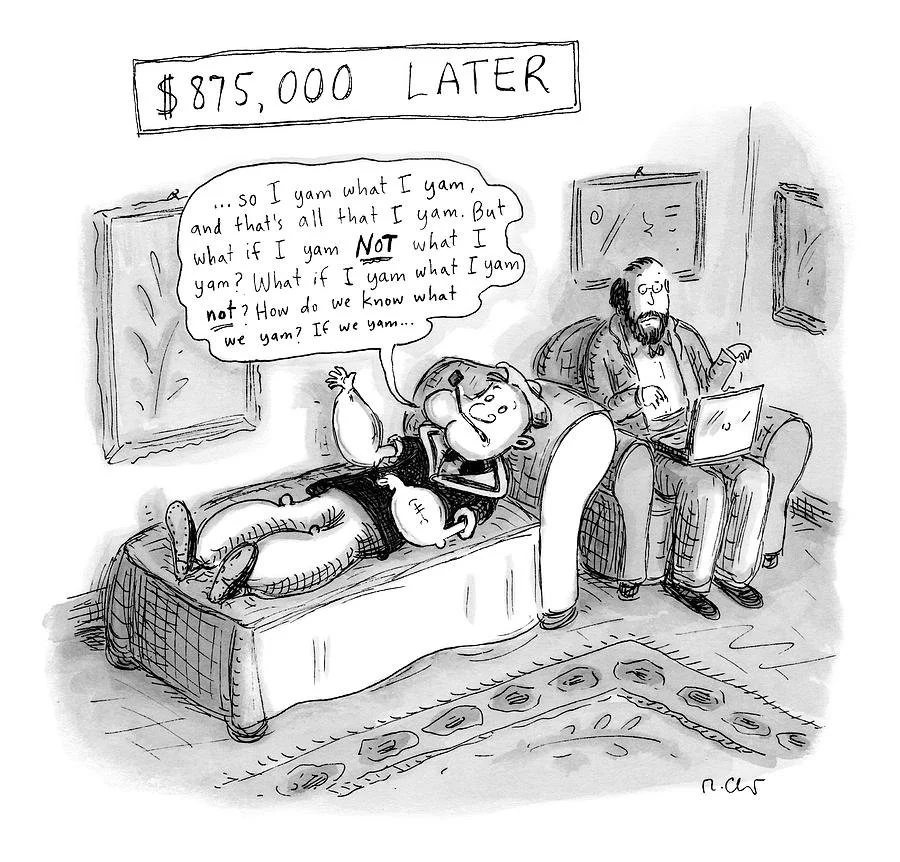
Popeye is a hopeless romantic, addicted to spinach and has some concerning vocal issues. He also has a fantastically self-aware motto: “I yam what I yam.” We are what we are and we can be authentically anything. An equanimous, calm, grounded, wise, compassionate self is a wonderful thing to be and it is just as real as a petty, annoyed, horny, tired, frustrated self. We can be authentically anything, if we are aware of it and allow ourselves to change.
Sometimes being myself means acknowledging that I am stuck trying to be good enough or impress others or write a perfect first blog for my website. This acknowledgment can be very supportive. It takes awareness to step off of the habitual merry-go-round and not take ourselves so personally. At times during my work as a therapist, I catch myself searching for something productive or useful to say or ask. Often this adding on gets in the way of noticing what is happening and just leads to more thinking and explaining. We are often focused on having an impact (like me as a therapist) that we deprive ourselves of letting the other or the environment impact us.
Therapy that supports real change is connected to embracing one’s “yam-ness”. This looks like being able to get in touch with one’s process and holding what is coming up lightly and with curiosity. Often the work starts and returns to a place of thinking and explaining one’s problem, gripping it tight and wanting to squeeze out an answer. When we stop searching, forcing, questioning, or looking for a grand theory — we find that who we are right now is always where change begins. What often stops us from accepting that is our own, often misguided, expectations for ourselves and others.
The biggest myth perpetuated by things like optimization culture, life hacking, looksmaxing, motivational speakers, life coaching, spiritual gurus, holistic wellness and fitness bros is the idea that our problems get to a place of permanent resolve. That we can have a perfect morning routine, diet and work life balance, and we should always have a regulated nervous system. We deserve to be on a clear track with our jobs, which should be great and our partners beautiful and our parents evolved and validate us for who we are. We live a lifestyle where we are thriving, making gains and being go getters. If we don’t feel that way, we need to clarify our “why” or set better boundaries or find our true passion. This sounds more like a corporation than a human to me. Humans are messed up and confusing. Go look at yourself and anyone you know if you don’t believe me.
Things can get better, of course, and they do when we live life as ourselves, right now, not who we think we should be, some day…